The blast from the 1954 nuclear weapons test on Bikini Atoll (Image: Public Domain; US Dept of Energy)
On the 80th anniversary of the bombing of Nagasaki and Hiroshima, the Planetary Health Initiative and the Blue Mountains Peace Collective hosted a Peace Symposium and Community Picnic to provide pathways for everyone to take steps for a more peaceful future. The event kicked off ICAN’s Week of Action for the Abolition [of Nuclear Weapons] and everyone was asked to send a message to the Prime Minister and Foreign Minister to urge them to sign and ratify the Treaty on the Prohibition of Nuclear Weapons in this term.You can add your voice to this urgent call here
Key Points:
Nuclear Abolition Campaign: The symposium marked the 80th anniversary of the bombing of Hiroshima, urging Australia to sign the Treaty on Prohibition of Nuclear Weapons through ICAN’s Week of Action.
Community-wide Peace Building: Over 130 participants heard diverse speakers emphasising that peace requires whole-of-community engagement, from addressing local social injustice to international diplomacy.
Key presenters included Japanese journalist Harumi Hayakawa, Quaker Rosemary Morrow, Rotarian Jennifer Scott, artist Matilda Emmerich, ICAN Ambassador Robert Tickner, Indonesian Ambassador Dr Siswo Pramono, MP Susan Templeman, and Mayor Mark Greenhill.
The Blue Mountains Peace Collective reflected on the inaugural Blue Mountains Peace Symposium and Community Picnic:
The foundations of sustainable peace must be built through a culture of peace in the minds and actions of people worldwide. As defined by the United Nations, the Culture of Peace is a “set of values, attitudes, modes of behaviour and ways of life that reject violence and prevent conflicts by tackling their root causes to solve problems through dialogue and negotiation among individuals, groups and nations” (UN Resolutions A/RES/52/13).
Real sustainable Peace is: • an end to violent conflict, • an end to injustices, and • a culture of peace.
Peace is not something we achieve, peace must be worked for and practised daily, Dharug man, Chris Tobin, reminded the large audience gathered for the Blue Mountains Peace Symposium and Picnic. That Saturday, August 2nd, truly was one of the coldest, wettest, most miserable days of winter, but Chris Tobin’s warm welcome and opening remarks set the tone for the symposium: peace is a whole of community need, the ‘business’ of all of us, at all times.
Chris Tobin’s opening address
The symposium was a collaboration of the Blue Mountains Planetary Health Initiative and the Blue Mountains Peace Collective, held at the Planetary Health Centre in Katoomba. The August 2nd date was chosen to mark the 80th anniversary of the dropping of the atomic bomb on Hiroshima. The symposium was thus part of the International Campaign to Abolish Nuclear Weapons’ (ICAN) Week of Action.
Harumi Hayakawa on Peace in Japan.
With the effects of nuclear weapons and the necessity for communities to promote, work on and embrace peace in everyday life both front of mind, it was fitting that the first speaker of the day was Japanese journalist Harumi Hayakawa. Harumi reminded us of the very great human cost of war; of why working for peace is so important.
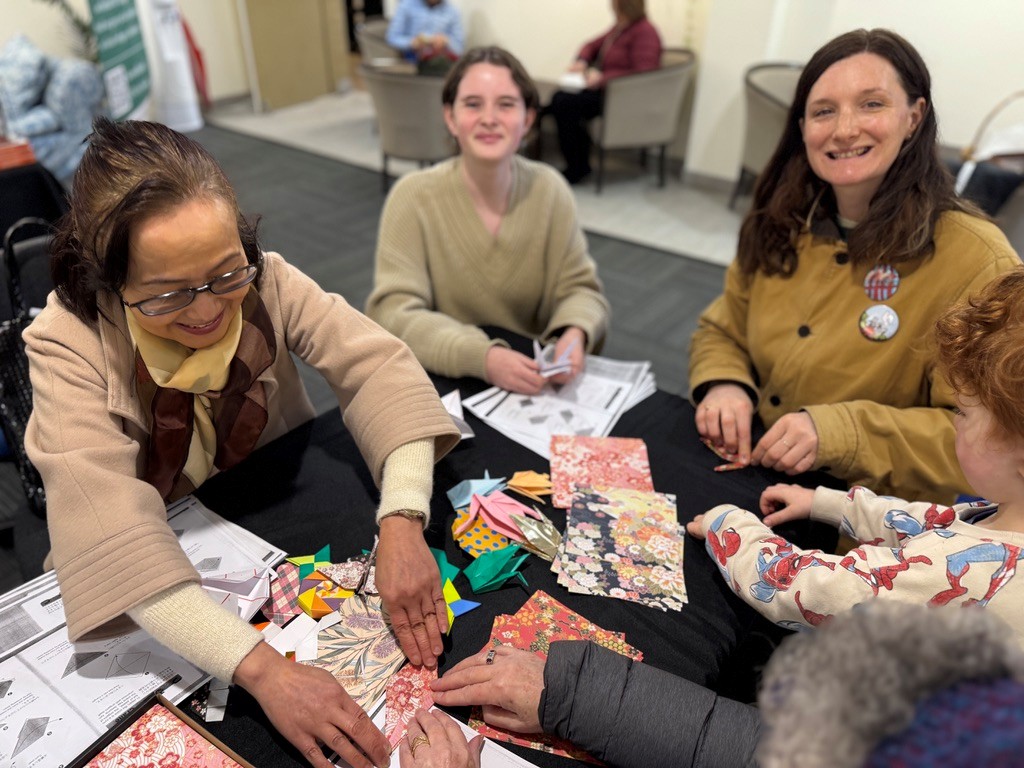
Later, in the lunch break, she helped children and adults to make the origami cranes that remain a poignant symbol of the desire for life of Sadako Sasaki, a child victim of the Hiroshima bomb.
Harumi teaching participants how to make origami cranes during the Peace Picnic.
Following on from Harumi, Jennifer Scott stated: ‘Peace is not the absence of war, it is the absence of want.’ Jennifer is an active Rotarian for peace. Both internationally and locally, Rotary engages in promoting peace through on-the-ground work (building education, ameliorating poverty), by providing peace studies fellowships and much more.
Jennifer, who works in education in Cambodia, encouraged the audience in hope, in doing what we each can do to develop a world where social justice makes peace possible.
Rotary International Director, Jennifer Scott
Similarly, Rowe Morrow OAM, in a video presentation, spoke of the long and influential work of Quakers toward a fairer and more peaceful world, whether that be through protest (Quakers being early among the protestors at Pine Gap), international activism (Quakers have a UN presence, as does Rotary) or local community support work.
Rowe Morrow speaking on Quakers and Peace
Attendees at the symposium ranged in age (it was great to see some children there) and this, too, was reflected in the morning session presentations. There was history of past peace actions: a screening of the 1946 documentary, ‘Indonesia Calling’, which movingly portrayed Australian Waterside Workers unionists refusing, and convincing others to join them in refusing, to service Dutch ships in Australian ports post-war. These ships were transporting armaments with the aim of the Dutch regaining control of the recently independent Indonesian population: united, local action helped prevent that outcome.
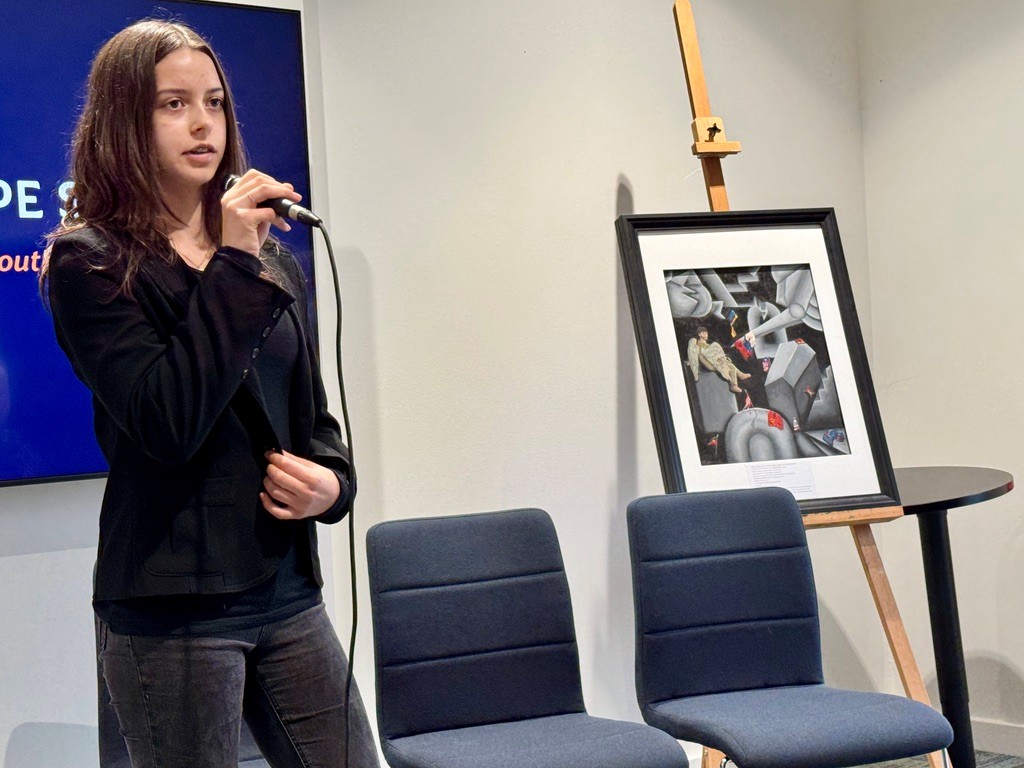
Peace Collective member Bruce Cornwell described past successful protests, and discussed potential future actions. Emerging activists, too, stood up to be counted: Year 11 student, Matilda Emmerich, already an artist and poet, presented her work, Where Hope Sits, giving older activists hope for the future.
ArtistMatilda Emmerich
There was more hope and pertinent comment in the performances of Ecopella and the Bearded Ladies community choirs, and in the lunchtime activities, for children and adults alike, in origami, badgemaking, book learning (local bookshop, RoseyRavelston) and in sharing picnic food from Bibi’s Kitchen.
Ecopella Community Choir
The afternoon session, chaired by Nick Franklin, emphasised the importance of formal, governmental promotion of peace, particularly in working to abolish nuclear weapons. Robert Tickner, Ambassador to ICAN (International Campaign to Abolish Nuclear Weapons), pointed to Australia having already supported the banning of land mines, cluster munitions and other weapons of war – and argued, eloquently, that it is time the Australian government took the next steps and signed and ratified the Treaty on the Prohibition of Nuclear Weapons (TPNW). This signing, he suggested would also enable Australia to develop more independent foreign and strategic policies.
ICAN Ambassador, Robert Tickner’s presentation
Blue Mountains Mayor, Mark Greenhill, member of the international Mayors for Peace, a group originally founded in 1982 by the mayor of Hiroshima, recognised the need for community action – campaigns against family violence, for gender equality and diversity, for example – as the essential supports for viable peace.
Mayor Mark Greenhill’s presentation
Our local federal member, Susan Templeman, outlined the federal government’s activities and policies in relation to the promotion of peace, noting that the Labor Party was committed to the signing of the TPNW (but when, the audience asked? When?).
Susan Templeman’s presentation
The three Australian representatives were joined by H.E. Dr Siswo Pramono, Indonesian Ambassador to Australia: the Indonesian government having become, in 2024, one of the 94 signatories to TPNW. Dr Pramono spoke as an advocate for Australia’s signing of the treaty to abolish nuclear weapons ASAP.
Dr Siswo Pramono’s presentation
Well over a hundred people filled the audience seats at the symposium and their questions and comments were an essential part of the ongoing conversation throughout the day. Given current events, many comments concerned the unjustified and unjustifiable imposition of unbearable conflict on the people of Gaza. Actions were discussed – sanctions, pressure on Australian and international politicians and governments, protests, local supports and more.
Australia’s problematic commitment to AUKUS and nuclear submarines received several mentions, as it should. The cost of these submarines could fund so much for so many Australians – reminding us all, yet again, that a world that favours war over peace is a world in which humans suffer terribly in conflicts, and also unnecessarily through lack of service provision, when money is instead spent on weaponry that kills.
Fortunately, early on the day, the news came through that the March for Humanity would proceed across Sydney Harbour Bridge the following day. We expected it then, and know now, that the march was HUGE and the Blue Mountains was brilliantly represented.
In all, the Peace Symposium of August the 2nd was a remarkable event. As Robert Tickner said, ‘today (was) absolutely inspirational’.
With many thanks to all who volunteered and participated,
Looking for a fun, educational and sustainable day out these school holidays?
Come along to Plate to Planet: Blue Mountains Food Security Fair in Katoomba on Saturday 10 October, with a line-up of free talks, activities and entertainment for all ages!
🌿 The Importance of Bioregions in Uncertain Times Join permaculture pioneer Rowe Morrow to explore how our land, water, food, energy and communities are connected - and how we can build a more resilient Blue Mountains.
🌱 Discover Old Man Saltbush Get up close to this remarkable native plant with Anne Elliot, and discover its potential as part of a more diverse and resilient food system.
🪱 Have a go at worm farming Learn how easy it can be to turn food scraps into valuable nutrients for your garden - with a hands-on worm farm activity from BMCC.
🎶 Enjoy live music Take a break, relax and soak up the atmosphere while enjoying live music by Olivia Dustmann throughout the day.
🎨 Kids` Corner - all day! Rock painting, crafts and story time, with plenty of fruit and veggie-inspired fun for younger visitors.
Explore local stalls, food, gardens, wildlife, sustainability and practical ideas for creating a more resilient food future.
Entry to the Fair and markets is free, with a range of free and paid sessions and workshops available throughout the day. Some sessions have limited capacity, so registration is recommended.
View the full program and register your place here: https://events.humanitix.com/blue-mountains-2026-food-security-fair
📅 Saturday 10 October | 9am–4pm 📍 Blue Mountains Planetary Health Centre, Katoomba...
Join Andris Heks, Yogic Psychotherapist, winner Best Actor, Blue Mountains, for his workshop to laugh as you never laughed before, as part of a movement to globalise people-bonding cheerfulness through kookaburra laughter contagion as an antidote to distressing world divisiveness.
Purchase your ticket here: https://events.humanitix.com/kookaburra-laughter-workshop
View the trailer and the GoFundMe page here: https://www.gofundme.com/f/globalise-unconditional-love-through-kookaburra-laughter
Key event information: - When? 10:15AM - 2:30PM, Sunday 4 October 2026 (1st day of Daylight Saving - 1 hour forward) - Where? Blue Mountains Planetary Health Centre, 33-39 Acacia St, Katoomba, NSW, 2780 - Fee? $60 or what you can afford - Note: please bring your own lunch
What to expect: - Learn how to stay cheerful for good - Learning the funny, human emulated, communal kookaburra laughter and meditation - How communal kookaburra laughter promotes bonding even amongst strangers - The awesome native treasure of the laughing kookaburra phenomenon - Why Kookaburra Yoga is the ‘most excellent of Yogas` - How communal kookaburra laughter contagion boosts the subtle and gross national product - How you could contribute to the kookaburra laughter contagion
This event is supported by Blue Mountains Planetary Health.
Purchase your ticket here: https://events.humanitix.com/kookaburra-laughter-workshop...
Come along to the Planetary Health Centre this Saturday for the next Skill Share Saturdays event!
This weekend`s agenda:
8:30AM - 10AM | Learn how to use your sewing machine class with Sherlie McMillan
8:30AM | Planetary Health Cafe open, serving Good Fat Pastry and Whisk and Pin
9AM - 10AM | Tai Chi and Qigong class with Virginia Field
10AM - 12PM | Learn how to grow WITH the Upper Blue Mountain permaculture workshop with Leni from Alchemy Farms
10AM - 3PM | Fashion Upcycling Workshop with Sherlie McMillan
10:30AM - 12PM | Learn to make focaccia from scratch with Laura Zucchetti (no experience needed)
1:30PM - 4:30PM | Planetary Health Bushcare with Karen Hising
For more information and to purchase a ticket, please visit the website: https://events.humanitix.com/skill-share-saturdays-at-the-planetary-health-centre...
Plate to Planet: Blue Mountains Food Security Fair 2026
📣HEADLINE SPEAKER📣
Our headline speaker is Julian Cribb AM – a renowned Australian science writer, journalist and author who has spent more than 50 years communicating science, agriculture, climate and global sustainability issues. He is the author of several influential books, including The Coming Famine (2010), Food or War (2019) and How to Fix a Broken Planet (2023), which explore the future of food systems, planetary health and humanity`s long-term survival.
He is widely recognised as one of Australia`s leading voices on global food security and sustainable development.
To register for his talk, and view the rest of the program, visit the website: https://events.humanitix.com/blue-mountains-2026-food-security-fair...
At our next Skill Share Saturdays event on Saturday 5th September, join Laura Zucchetti at 10:30am to learn how to make focaccia from scratch!
Come along for a 90 min class where you`ll mix, rest and stretch your own focaccia dough from start to finish, guided every step of the way. You’ll take home your dough to bake on the day in your own oven.
Sign up to this session, and view the other offerings on the day via this link: https://events.humanitix.com/skill-share-saturdays-at-the-planetary-health-centre...
Plate to Planet: Blue Mountains Food Security Fair 2026
We are pleased to announce that the program and registration for Plate to Planet: Blue Mountains Food Security Fair 2026 is now live!
Follow this link to view the program and register your place: https://events.humanitix.com/blue-mountains-2026-food-security-fair
Key information:
When? Saturday 10 October, 9AM - 4PM
Where? Blue Mountains Planetary Health Centre, Katoomba
Who is it for? Families, gardeners, enthusiasts, community groups and businesses, anyone looking to learn about how to be more resilient through local and sustainable food systems.
What to expect? Talks, workshops, demos, market stalls, family activities, music, food
Is there a cost? Entry to the Fair and Markets is free. Talks and workshops are ticketed (both free and paid) and have limited capacity, so please register in advance.
Program highlights:
🌏Headline talk: The age of renewable Food – Julian Cribb AM 🎋Wild edibles foraging workshops – Diego Bonetto, Eat More Weeds 🏞️The importance of bioregions in uncertain times – Rowe Morrow, Permaculture Matters 🥒Home canning and food preservation workshop – Kirsty Berté, Permaculture Hawkesbury Valley 🏡Designing your own Permaculture Property – Leni Nyssen, Alchemy Farms 🍃Utilising what’s in front of you – Uncle Lex, The Ganya Shed 🪱How to worm farm - BMCC 🎸Live music by Olivia Dustmann 🌾Community crop and seed swap
Tickets are limited so please register your place now: https://events.humanitix.com/blue-mountains-2026-food-security-fair
We are also seeking stallholders for the event. If you are a grower, retailer, community organisation or business that would like to get involved, please reach out to [email protected]!...
Thank you to everyone that joined us at the Planetary Health Centre on Saturday for the first of our Skill Share Saturdays program!
The Centre was a hive of activity all day, and we heard from @alchemyfarms_permaculture, the @ediblegardentrailbluemountains team and Andy Mann. Also thanks to Sherlie McMillan from Greater Blue Mountains Rotary for teaching the Fashion Upcycling workshop, and Virginia Field for the Tai Chi and Qigong class.
The next event will be held on Saturday 1st August - you can register your place here: https://events.humanitix.com/skill-share-saturdays-at-the-planetary-health-centre
🖐Get involved!
Do you have a skill, program or interest that promotes planetary health that you`d be willing to share with members of the local community? We are looking for more workshop and session hosts for our future events.
Join us at the Planetary Health Centre in Katoomba on the first Saturday of every month for Skill Share Saturdays!
Our July program includes: - What to grow in a Blue Mountains climate - Eating for Earth - Tai Chi and Qigong - Fashion upcycling and clothing reuse workshop - How to get involved with the Edible Garden Trail
You are also welcome to bring any surplus seeds or produce for our Crop Swap, or wind down in the Planetary Health Cafe (until 2pm).
If you have a skill that you want to share, or any questions or queries, please contact [email protected]
Visit the website to view the full program of events and register your place.
Join Andy Mann, a 23 year old Lawson local, for their Eating for Earth session 🌏
Eating for Earth is a judgement-free plant-based educational workshop that all types of eaters are encouraged to attend. There will be a presentation about the environmental impact of diets, a discussion section, and best of all, food! The food will be fully plant-based.
Andy wants to help inform our passionate community about how we can better reduce dietary environmental impact.
The session will run from 11AM - 12PM on Saturday 4th July.
Other sessions include: - What to grow in a Blue Mountains Climate - Fashion Upcycling - Tai Chi and Qigong - Bushcare on the Planetary Health site - How to get involved with the Edible Garden Trail
To register your place, visit our website: https://events.humanitix.com/skill-share-saturdays-at-the-planetary-health-centre...
We’re excited to announce the second Blue Mountains Food Security Fair, taking place in Katoomba in October 2026.
This annual event will bring together growers, thinkers, makers, and community members to explore one of the most important challenges of our time: how we grow, share, and sustain food in a changing world.
Across the weekend, we’ll be exploring themes including: - Healthy soil and regenerative systems - Food and human health - Plant-based food futures - Home and community food resilience - Water-sensitive and climate-adapted growing - Indigenous food knowledge and systems - School food systems - Australia’s food procurement - Global food security challenges Expect a dynamic program of inspiring speakers, practical workshops, and hands-on experiences designed to leave you informed, empowered, and connected.
Key information Date: Weekend of 10th October 2026 Location: Blue Mountains Planetary Health Centre, Katoomba, NSW We’ll be announcing speakers and program details soon.
We are also inviting expressions of interest from individuals and organisations who would like to contribute to the program, host workshops, run a stall or partner with us.
Do you struggle making the most of your veggie garden all year round?
Join Leni from @alchemyfarms_permaculture on Saturday 4th July for her Permaculture Workshop: Learn how to grow WITH the Upper Blue Mountains seasons, rather than battling against them.
During the two-hour session, you`ll cover crop selection for different seasons, what to grow from seeds vs seedlings, frost and wind protection, and nurturing your soil with a seasonal cycle.
Register for this and other sessions as part of our Skill Share Saturdays program via this link: https://events.humanitix.com/skill-share-saturdays-at-the-planetary-health-centre...
“Every body can help the planet” is the tagline of Earthly Remains, a not-for-profit organisation set up to advocate for human composting as a more sustainable death care option in Australia.