Planetary Health NewsStrengthening community and restoring the health of our planet.
Australia’s native bees struggled after the Black Summer fires – but a world-first solution brought them buzzing back
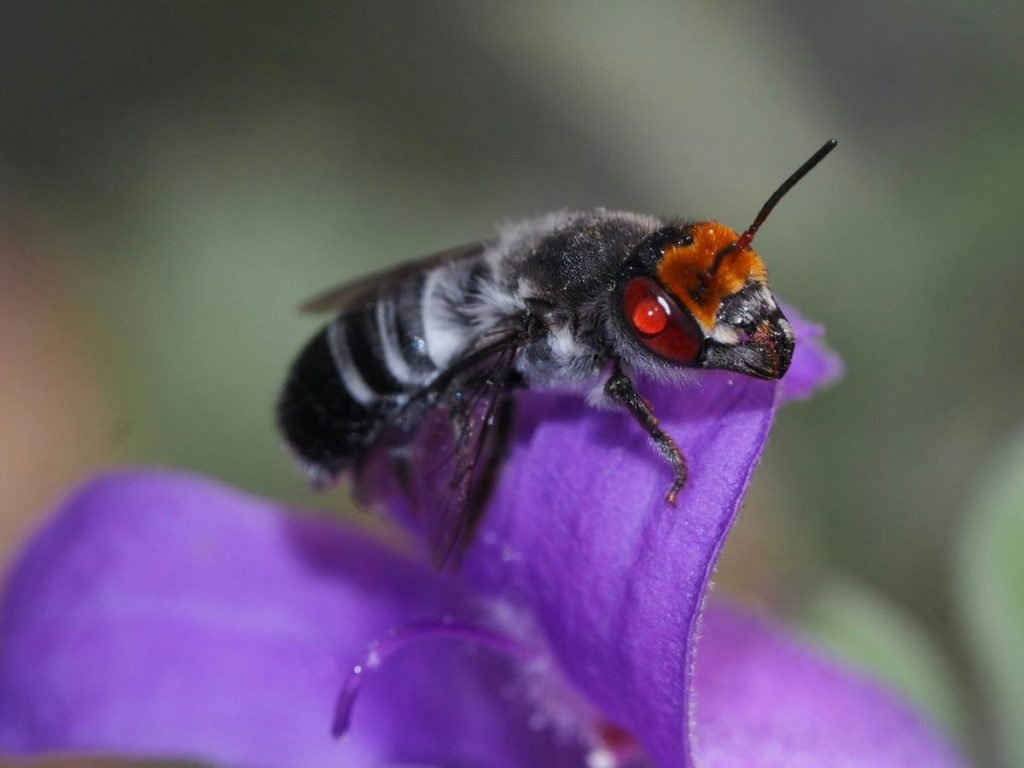
Photo: Kit Prendergast (@bee.babette_performer)
After a devastating bushfire, efforts to help nature recover typically focus on vertebrates and plants. Yet extreme fires can threaten insects, too.
After the Black Summer fires of 2019–20, I embarked on world-first research into whether “bee hotels” – a type of artificial nesting structure – could help native bees recolonise an area.
I installed 1,000 bee hotels in the Jarrah forests of Western Australia, parts of which burned during the Black Summer fires.
After months of monitoring, I concluded – with great excitement and relief – that the project was a success. Native bees were using the structures to lay eggs and raise young. The work shows pollinators such as bees can be aided after fires, to help bring damaged landscapes back to life.
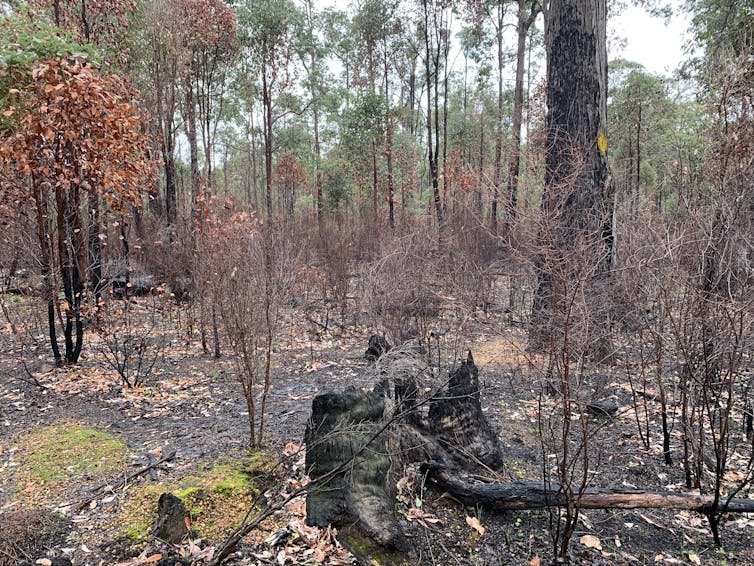
WA’s Jarrah Forest was affected by the Black Summer fires. Photo: Kit Prendergast
Native bees typically nest in holes in trees that occur naturally when beetles bore through wood. When fire destroys trees, bees can be left without a place to nest and reproduce. This prevents them from recolonising habitats after fire.
Under climate change, bushfires in Australia are becoming more frequent and severe. Wood-nesting bees are especially vulnerable to bushfires. For example, fires are recognised as a major threat to the glittering green carpenter bee (Xylocopa aerata), which creates its own holes in wood to nest in.
The worsening fires take place at a time when global populations of wild pollinators, such as bees, are in steady decline. This problem has been well-publicised, although the plight of Australia’s native bees has received less attention.
My research tested whether bee hotels could help our native bees bounce back after fire.
What the research found
The Jarrah Forest of southwest Western Australia is a biodiversity hotspot. The 1,000 bee hotels were installed across five sites in the northern part of the forest, where bushfires burned during the summer of 2019–20.
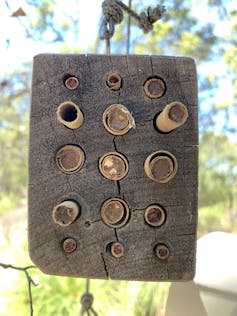
One type of bee hotel used by the researcher. Photo: Kit Prendergast
Bee hotels replicate the holes in wood that native bees nest in. In August 2021, I installed bee hotels of two types: wooden blocks with 15 holes drilled in them, and bunches of about 50 bamboo stems bundled together. I monitored them from September 2021 to March 2022.
At the end of the period I concluded – with great excitement and relief – that the project was a success. Across all bee hotels at the five sites, 832 cavities were occupied by native bees.
Assuming four cells per cavity for each offspring, this meant more than 3,300 native bees would likely emerge in the next generation.
Uptake by bees was initially slow. This was to be expected, because the main group of species that used bee hotels – from the Megachile genus – tend to not be active in the region until late spring.
I found the nests were also used by bees of the genus Hylaeus, as well as tiny Exoneura bees. Other inhabitants included wasps, spiders, ants and crickets.
I also surveyed three burnt sites where bee hotels were not installed. There, I recorded the numbers of native bees foraging on flowers, and compared it to the sites with bee hotels. More native bees were present at the latter sites, which reinforced my findings.
Importantly, the research allowed natural recolonisation. It did not involve installing bee hotels at unburnt sites, then moving them to burnt areas once they were occupied. This could have been disastrous.
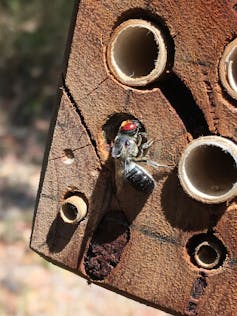
A bee at the entrance of the bee hotel. Photo: Kit Prendergast
Aside from depleting one population, it may have meant native bees were moved to an area where there were not enough flowers, or were forced to compete with existing bee populations.
The research also showed European honey bees could pose a problem for native bees in fire-damaged landscapes. At sites with a higher density of honey bees, fewer native bees were foraging and fewer nests were occupied in the bee hotels.
This supports previous findings by myself and others that honey bees can negativelyaffect native bees. It adds further evidence that honey bees should not be permitted in sensitive habitats, such as bushland following fire or in national parks.
Empowering bee-saving efforts
My research provides proof that bee hotels can aid in the recovery of cavity-nesting native bees after fires.
This work fills a major gap. While there has been much attention on the recovery of furry animals and plants after fires, there has been far less investment into the recovery of plant pollinators.
Looking for a fun, educational and sustainable day out these school holidays?
Come along to Plate to Planet: Blue Mountains Food Security Fair in Katoomba on Saturday 10 October, with a line-up of free talks, activities and entertainment for all ages!
🌿 The Importance of Bioregions in Uncertain Times Join permaculture pioneer Rowe Morrow to explore how our land, water, food, energy and communities are connected - and how we can build a more resilient Blue Mountains.
🌱 Discover Old Man Saltbush Get up close to this remarkable native plant with Anne Elliot, and discover its potential as part of a more diverse and resilient food system.
🪱 Have a go at worm farming Learn how easy it can be to turn food scraps into valuable nutrients for your garden - with a hands-on worm farm activity from BMCC.
🎶 Enjoy live music Take a break, relax and soak up the atmosphere while enjoying live music by Olivia Dustmann throughout the day.
🎨 Kids` Corner - all day! Rock painting, crafts and story time, with plenty of fruit and veggie-inspired fun for younger visitors.
Explore local stalls, food, gardens, wildlife, sustainability and practical ideas for creating a more resilient food future.
Entry to the Fair and markets is free, with a range of free and paid sessions and workshops available throughout the day. Some sessions have limited capacity, so registration is recommended.
View the full program and register your place here: https://events.humanitix.com/blue-mountains-2026-food-security-fair
📅 Saturday 10 October | 9am–4pm 📍 Blue Mountains Planetary Health Centre, Katoomba...
Join Andris Heks, Yogic Psychotherapist, winner Best Actor, Blue Mountains, for his workshop to laugh as you never laughed before, as part of a movement to globalise people-bonding cheerfulness through kookaburra laughter contagion as an antidote to distressing world divisiveness.
Purchase your ticket here: https://events.humanitix.com/kookaburra-laughter-workshop
View the trailer and the GoFundMe page here: https://www.gofundme.com/f/globalise-unconditional-love-through-kookaburra-laughter
Key event information: - When? 10:15AM - 2:30PM, Sunday 4 October 2026 (1st day of Daylight Saving - 1 hour forward) - Where? Blue Mountains Planetary Health Centre, 33-39 Acacia St, Katoomba, NSW, 2780 - Fee? $60 or what you can afford - Note: please bring your own lunch
What to expect: - Learn how to stay cheerful for good - Learning the funny, human emulated, communal kookaburra laughter and meditation - How communal kookaburra laughter promotes bonding even amongst strangers - The awesome native treasure of the laughing kookaburra phenomenon - Why Kookaburra Yoga is the ‘most excellent of Yogas` - How communal kookaburra laughter contagion boosts the subtle and gross national product - How you could contribute to the kookaburra laughter contagion
This event is supported by Blue Mountains Planetary Health.
Purchase your ticket here: https://events.humanitix.com/kookaburra-laughter-workshop...
Come along to the Planetary Health Centre this Saturday for the next Skill Share Saturdays event!
This weekend`s agenda:
8:30AM - 10AM | Learn how to use your sewing machine class with Sherlie McMillan
8:30AM | Planetary Health Cafe open, serving Good Fat Pastry and Whisk and Pin
9AM - 10AM | Tai Chi and Qigong class with Virginia Field
10AM - 12PM | Learn how to grow WITH the Upper Blue Mountain permaculture workshop with Leni from Alchemy Farms
10AM - 3PM | Fashion Upcycling Workshop with Sherlie McMillan
10:30AM - 12PM | Learn to make focaccia from scratch with Laura Zucchetti (no experience needed)
1:30PM - 4:30PM | Planetary Health Bushcare with Karen Hising
For more information and to purchase a ticket, please visit the website: https://events.humanitix.com/skill-share-saturdays-at-the-planetary-health-centre...
Plate to Planet: Blue Mountains Food Security Fair 2026
📣HEADLINE SPEAKER📣
Our headline speaker is Julian Cribb AM – a renowned Australian science writer, journalist and author who has spent more than 50 years communicating science, agriculture, climate and global sustainability issues. He is the author of several influential books, including The Coming Famine (2010), Food or War (2019) and How to Fix a Broken Planet (2023), which explore the future of food systems, planetary health and humanity`s long-term survival.
He is widely recognised as one of Australia`s leading voices on global food security and sustainable development.
To register for his talk, and view the rest of the program, visit the website: https://events.humanitix.com/blue-mountains-2026-food-security-fair...
At our next Skill Share Saturdays event on Saturday 5th September, join Laura Zucchetti at 10:30am to learn how to make focaccia from scratch!
Come along for a 90 min class where you`ll mix, rest and stretch your own focaccia dough from start to finish, guided every step of the way. You’ll take home your dough to bake on the day in your own oven.
Sign up to this session, and view the other offerings on the day via this link: https://events.humanitix.com/skill-share-saturdays-at-the-planetary-health-centre...
Plate to Planet: Blue Mountains Food Security Fair 2026
We are pleased to announce that the program and registration for Plate to Planet: Blue Mountains Food Security Fair 2026 is now live!
Follow this link to view the program and register your place: https://events.humanitix.com/blue-mountains-2026-food-security-fair
Key information:
When? Saturday 10 October, 9AM - 4PM
Where? Blue Mountains Planetary Health Centre, Katoomba
Who is it for? Families, gardeners, enthusiasts, community groups and businesses, anyone looking to learn about how to be more resilient through local and sustainable food systems.
What to expect? Talks, workshops, demos, market stalls, family activities, music, food
Is there a cost? Entry to the Fair and Markets is free. Talks and workshops are ticketed (both free and paid) and have limited capacity, so please register in advance.
Program highlights:
🌏Headline talk: The age of renewable Food – Julian Cribb AM 🎋Wild edibles foraging workshops – Diego Bonetto, Eat More Weeds 🏞️The importance of bioregions in uncertain times – Rowe Morrow, Permaculture Matters 🥒Home canning and food preservation workshop – Kirsty Berté, Permaculture Hawkesbury Valley 🏡Designing your own Permaculture Property – Leni Nyssen, Alchemy Farms 🍃Utilising what’s in front of you – Uncle Lex, The Ganya Shed 🪱How to worm farm - BMCC 🎸Live music by Olivia Dustmann 🌾Community crop and seed swap
Tickets are limited so please register your place now: https://events.humanitix.com/blue-mountains-2026-food-security-fair
We are also seeking stallholders for the event. If you are a grower, retailer, community organisation or business that would like to get involved, please reach out to [email protected]!...
Thank you to everyone that joined us at the Planetary Health Centre on Saturday for the first of our Skill Share Saturdays program!
The Centre was a hive of activity all day, and we heard from @alchemyfarms_permaculture, the @ediblegardentrailbluemountains team and Andy Mann. Also thanks to Sherlie McMillan from Greater Blue Mountains Rotary for teaching the Fashion Upcycling workshop, and Virginia Field for the Tai Chi and Qigong class.
The next event will be held on Saturday 1st August - you can register your place here: https://events.humanitix.com/skill-share-saturdays-at-the-planetary-health-centre
🖐Get involved!
Do you have a skill, program or interest that promotes planetary health that you`d be willing to share with members of the local community? We are looking for more workshop and session hosts for our future events.
Join us at the Planetary Health Centre in Katoomba on the first Saturday of every month for Skill Share Saturdays!
Our July program includes: - What to grow in a Blue Mountains climate - Eating for Earth - Tai Chi and Qigong - Fashion upcycling and clothing reuse workshop - How to get involved with the Edible Garden Trail
You are also welcome to bring any surplus seeds or produce for our Crop Swap, or wind down in the Planetary Health Cafe (until 2pm).
If you have a skill that you want to share, or any questions or queries, please contact [email protected]
Visit the website to view the full program of events and register your place.
Join Andy Mann, a 23 year old Lawson local, for their Eating for Earth session 🌏
Eating for Earth is a judgement-free plant-based educational workshop that all types of eaters are encouraged to attend. There will be a presentation about the environmental impact of diets, a discussion section, and best of all, food! The food will be fully plant-based.
Andy wants to help inform our passionate community about how we can better reduce dietary environmental impact.
The session will run from 11AM - 12PM on Saturday 4th July.
Other sessions include: - What to grow in a Blue Mountains Climate - Fashion Upcycling - Tai Chi and Qigong - Bushcare on the Planetary Health site - How to get involved with the Edible Garden Trail
To register your place, visit our website: https://events.humanitix.com/skill-share-saturdays-at-the-planetary-health-centre...
We’re excited to announce the second Blue Mountains Food Security Fair, taking place in Katoomba in October 2026.
This annual event will bring together growers, thinkers, makers, and community members to explore one of the most important challenges of our time: how we grow, share, and sustain food in a changing world.
Across the weekend, we’ll be exploring themes including: - Healthy soil and regenerative systems - Food and human health - Plant-based food futures - Home and community food resilience - Water-sensitive and climate-adapted growing - Indigenous food knowledge and systems - School food systems - Australia’s food procurement - Global food security challenges Expect a dynamic program of inspiring speakers, practical workshops, and hands-on experiences designed to leave you informed, empowered, and connected.
Key information Date: Weekend of 10th October 2026 Location: Blue Mountains Planetary Health Centre, Katoomba, NSW We’ll be announcing speakers and program details soon.
We are also inviting expressions of interest from individuals and organisations who would like to contribute to the program, host workshops, run a stall or partner with us.
Do you struggle making the most of your veggie garden all year round?
Join Leni from @alchemyfarms_permaculture on Saturday 4th July for her Permaculture Workshop: Learn how to grow WITH the Upper Blue Mountains seasons, rather than battling against them.
During the two-hour session, you`ll cover crop selection for different seasons, what to grow from seeds vs seedlings, frost and wind protection, and nurturing your soil with a seasonal cycle.
Register for this and other sessions as part of our Skill Share Saturdays program via this link: https://events.humanitix.com/skill-share-saturdays-at-the-planetary-health-centre...
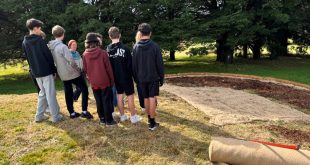
There is a little bit of magic happening on Wednesdays at the Planetary Health Centre as young volunteers from Kindlehill School, and Council staff, work together to create a demonstration site for the wider community. This hands-on program is inspiring all involved, including teacher Sarah Daniel.