Planetary Health NewsStrengthening community and restoring the health of our planet.
Give Peace a Chance
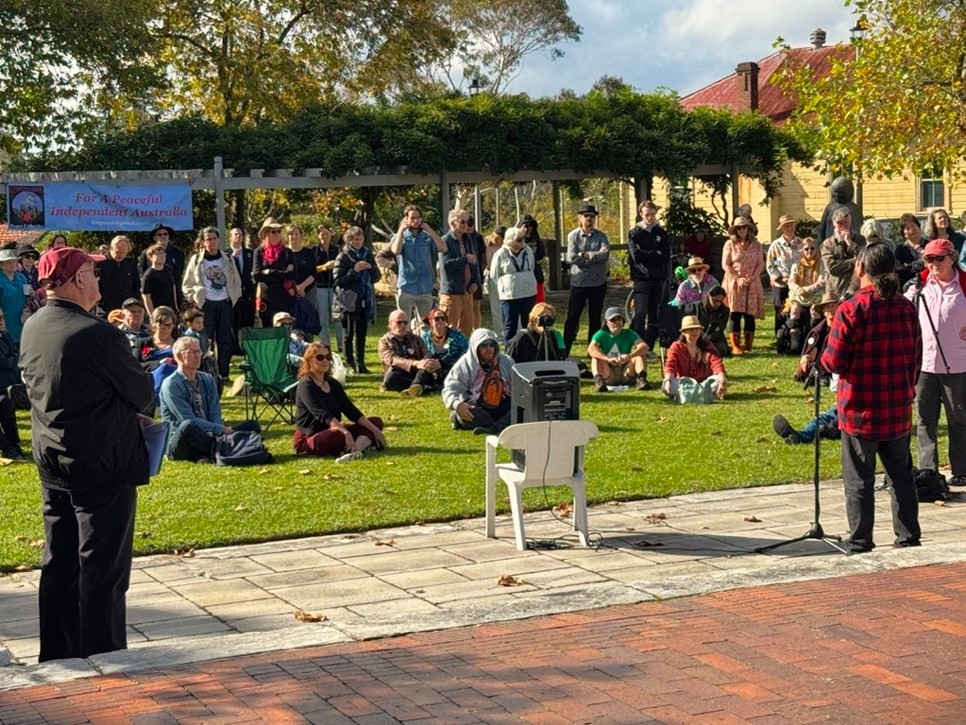
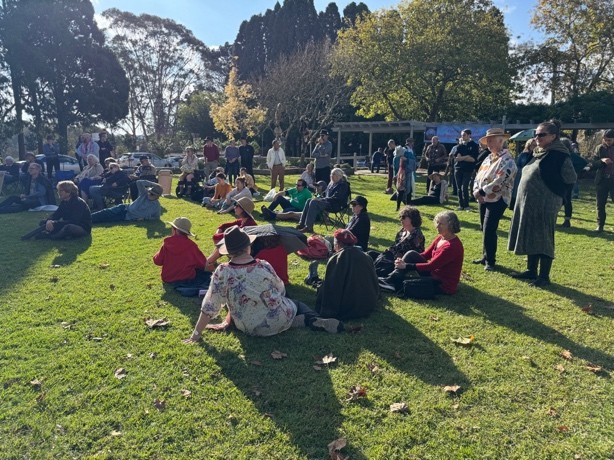
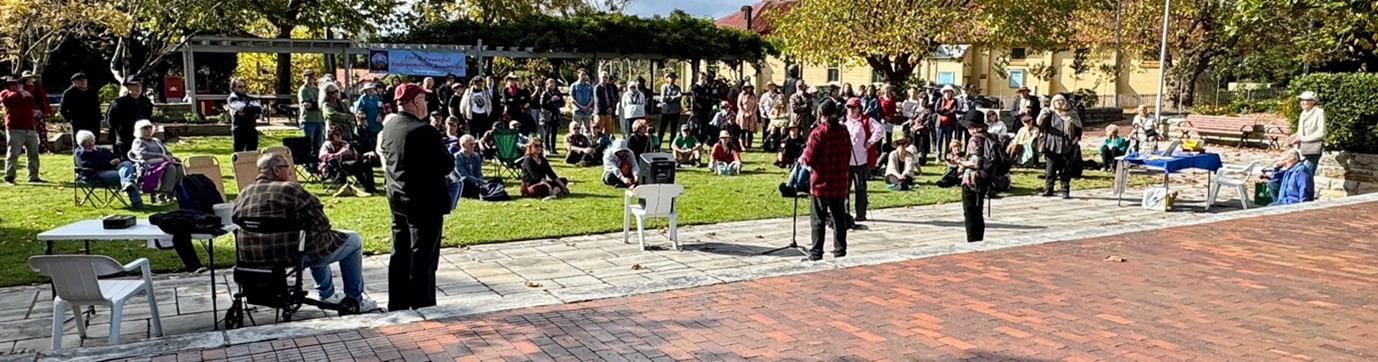
In a moving call for peace on Anzac Day, over 80 people gathered in the golden afternoon light at Peace Park in Katoomba to reflect on war and ask the hard questions about its grim reality. The day was interspersed with reflections, poetry, a minute of silence, and songs by The Bearded Ladies Choir.
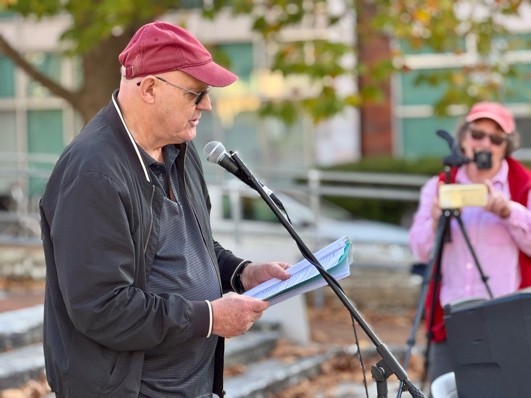
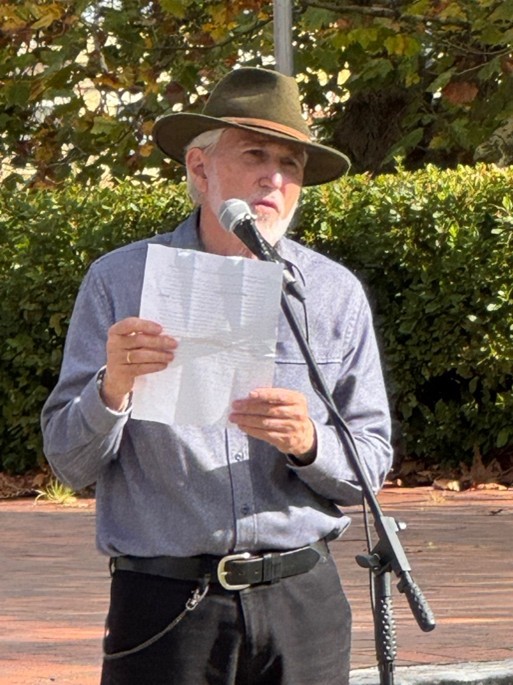
MC Jon Atkins, from the Blue Mountains Peace Collective, emphasised that we need to “learn from past military disasters so that we can minimise them occurring in the future … an important way of honouring our war dead.”
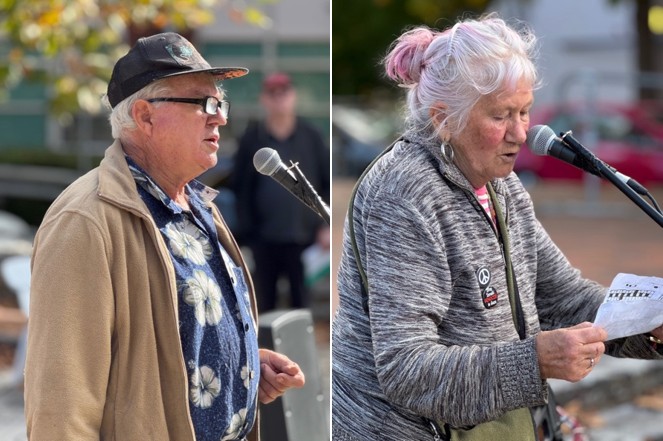
Jon Atkins
He stressed that tributes paid to the victims of WW1 (and other wars) need to be inclusive. These victims include the 250-300 Indigenous Australians who lost their lives in WW1 (out of an estimated 1,000-1,300 who enlisted); “those that returned with debilitating psychological or physical injuries”; those that suffered on the home front when their loved ones were killed, maimed and traumatised; as well as those who campaigned against the war and opposed conscription and who were then “vilified and punished by the State for the principled stand they took.”
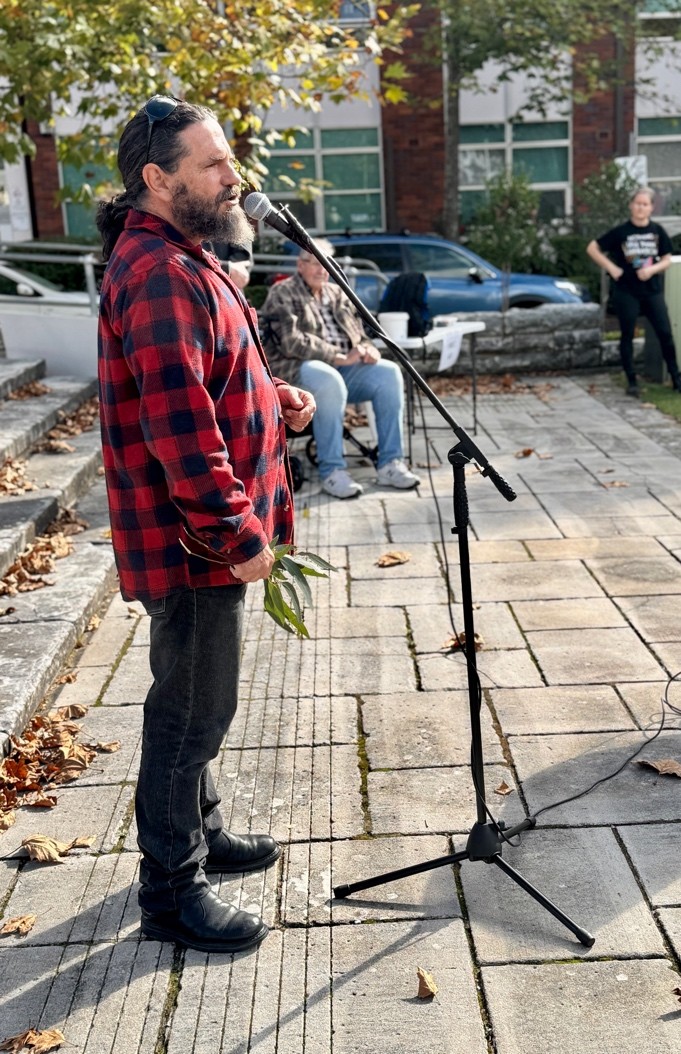
Dharug man Chris Tobin
Dharug man Chris Tobin recognised the sacrifice of those Indigenous Australians who lost their lives: but with sadness, not pride. He pointed out that Australia’s terrible past treatment of Indigenous people is still happening to Indigenous peoples around the world and “just because you take something doesn’t mean it’s yours”. Despite this, he urged people to put down their guns: “We’re going to win by love and education.”
“When we acknowledge Country,” he continued, “we’re dismantling the nationalism that is so destructive around the world.”
Rev. Mark Hillis
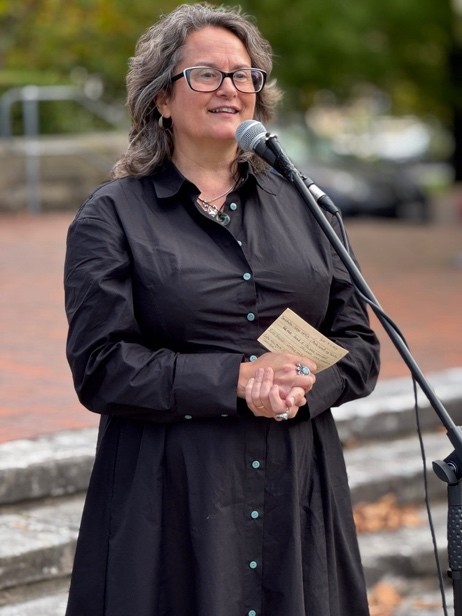
The importance of questioning the Anzac narrative was reiterated by Rev. Mark Hillis from the Leura Uniting Church, who read from Australian historian Henry Reynolds in Pearls and Irritations, and historian Dr Naomi Parry Duncan, the co-author of New South Wales and the Great War, who described herself as “a pacifist who wrote a book about war”.
Dr Naomi Parry Duncan
What is clear from history is that Australia in 1915 “was one of the most democratic, prosperous and well-managed societies in the world; the product of over a hundred years of nation building … The war opened up deep and damaging divisions in Australian society that were at best latent in 1914. Class division and resulting industrial strife intensified. The conscription debates of 1916 and 1917 tore communities, families and friendships asunder.” (Reynolds)
Naomi elaborated on this: “War sucked the life out of our economy. Sixty-two thousand people were killed; one hundred and fifty thousand were maimed … it’s not defence, it’s war mongering.”
She spoke with deep emotion about waking early that morning and seeing an incredible dark moon in the shape of a sickle and thinking of all those living in conflict today: “We are all people under one moon and one sun. Down with nationalism and up with collectivism!”
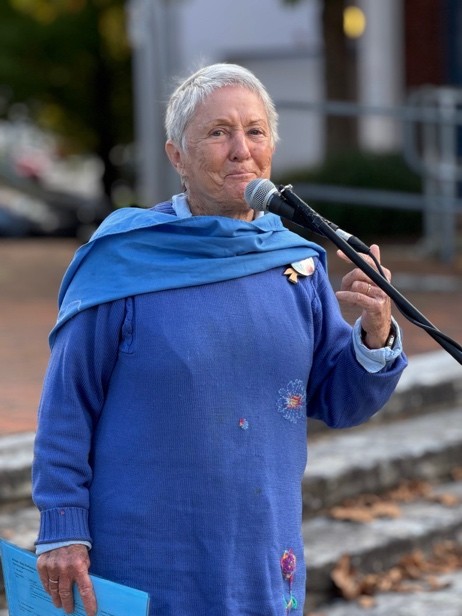
Rowe Morrow
Quaker Rowe Morrow spoke of how the impacts of war go on for generations, starting with the dispossession of Indigenous nations. It’s something she’s seen and felt as she’s worked in refugee camps around the world over the last 50 years. She recalled that even as a child she’d been haunted by “the terrible things they do to young men” when she visited convalescing returned soldiers at the Sunset Home in Perth.
She went on to speak of the “immorality of destroying peace for gain”, and the ‘fake news’ that sends young men to be maimed and die so that some may profit.
Rowe then read the poem Weapon by Judith Wright, which highlights the self-destructive nature of the types of power and ambition that drive this ‘fake news’: the power and ambition which take countries into war and destroy our compassion for those we kill.
“We will have to find a way through this age of untruth,” she urged.
Weapon, by Judith Wright
The will to power destroys the power to will. The weapon made, we cannot help but use it; it drags us with its own momentum still.
The power to kill compounds the need to kill. Grown out of hand, the heart cannot refuse it; the will to power undoes the power to will.
Though as we strike we cry ‘I did not choose it,’ it drags us with its own momentum still. In the one stroke we win the world and lose it. The will to power destroys the power to will.
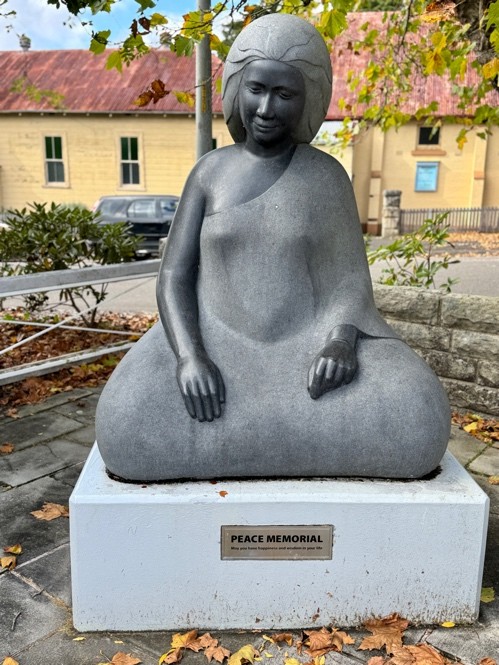
Tom Coley’s ‘Peace Memorial’ in Peace Park, donated to Blue Mountains City Council by the sculptor in 2009.
Poets Brian Bell and June
Peace Building
The Anzac Day Reflection was organised by the Blue Mountains Peace Collective. This local group formed in June 2023 when Don McGregor, Bruce Cornwall, Kathie Herbert, Eunice Goodberg, and Rev. Mark Hillis and Rev. Myung Hwa Park from the Uniting Church in Leura, met to see what they could do to advocate for peace. Their first event, a Vigil for Gaza, attracted around 70 people on 18 October of that year.
In his last reflection, Jon Atkin recalled an Anzac Day address in 2013 by the former Governor of Tasmania, Peter Underwood AC, who said:
“All our remembrances and honours are meaningless, unless we also vow to become resolute about peace because that is what those whom we remember and honour on this special day thought they were dying for.“
“At the time, Peter Underwood also called for a Peace Institute to be created – not a bad idea!” said Jon.
Jon then went on to outline the Peace Collective’s recommendations for peace building.
1. Support official recognition of the Frontier Wars and the impact they had on Indigenous dispossession.
He quoted historian Henry Reynolds who has said:
“Our National Day of Lament is for those that died overseas in wars chosen for us by our great and powerful friends, most of the time against enemies who would never have been able to threaten Australia.
How is that commensurate with frontier wars fought in Australia about ownership and control of the continent itself? For us, this must be of far greater significance than the balance of power in Europe or the scramble to carve up the remains of the Ottoman Empire.”
2. Call for substantial reform of war powers by the Commonwealth Parliament
The Peace Collective supports the Australians for War Powers Reform (AWPR) and their long campaign to democratise existing war powers.
In response to the parliamentary report on how Australia makes decisions to send service personnel into international armed conflict, which was tabled in Parliament on March 31, 2023, Australians for War Powers Reform argued that the outcome of the review was very disappointing.
While the Committee recommended some changes by promising better transparency and accountability, Australians for War Powers Reform criticised the report for refusing to adopt a fully democratic system where MPs are able to vote before Australia joins an overseas war.
Compared to many European parliamentary democracies, Australia can still be classified as having weak powers related to parliamentary action required for the deployment of military force overseas.
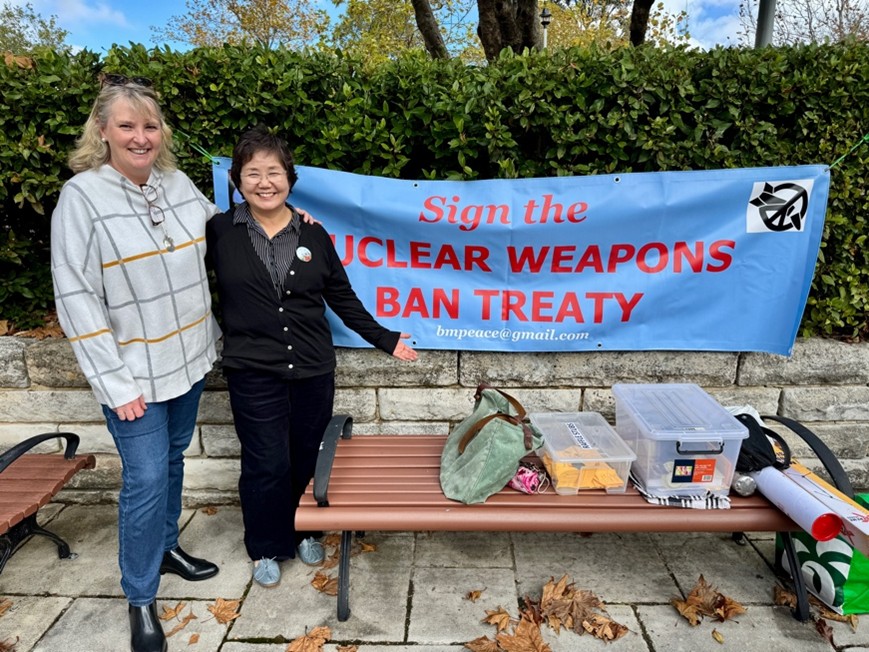
3. Back the signing and ratification of the UN Treaty on the Prohibition of Nuclear Weapons (also known as Nuclear Weapon Ban Treaty)
The Treaty has been signed by 94 nations. Of these 73 nations have proceeded to ratify it.
Australia has yet to sign and ratify the Treaty.
4. Call for independent foreign and defence policies
As Paul Keating has argued, both the Coalition and Labor’s commitment to the AUKUS pact diminishes our security and compromises our sovereignity.
Do our policies serve to defend the nation or are they geared to serving the hegemonic interests of ‘a powerful ally’?
Given Australia’s membership of the United Nations, and in accordance with the UN Charter, do the policies serve to maintain international peace and security and uphold international law?
5. Support genuine ‘remembrance’ on Anzac Day
How can we protect Anzac Day as an occasion devoted to reflection and mourning and prevent it from becoming a political tool or a justification for future bloodbaths?
Learn more about history as well as future predictions to inform your decision making in the present. You can do so at these upcoming local events; Blackheath History Forum: 24 May 4-6pm, Blackheath Public School. Historian Stephen Gapps will be in conversation with Dr Naomi Parry Duncan about his latest book Uprising: War in the Colony of NSW 1838 to 1844. Dr Keith Suter’s presentation on Global Directions, 5pm Sunday 25 May, Leura Uniting Church
Blue Mountains City Council has joined ‘Mayors for Peace‘: a global movement calling for the abolition of nuclear weapons and lasting world peace. Help grow this Reflection on Peace into an even bigger annual event. See similar actions being taken in Marrickville by the Marrickville Peace Group: https://marrickvillepeacegroup.org/ )
Join Andris Heks, Yogic Psychotherapist, winner Best Actor, Blue Mountains, for his workshop to laugh as you never laughed before, as part of a movement to globalise people-bonding cheerfulness through kookaburra laughter contagion as an antidote to distressing world divisiveness.
Purchase your ticket here: https://events.humanitix.com/kookaburra-laughter-workshop
View the trailer and the GoFundMe page here: https://www.gofundme.com/f/globalise-unconditional-love-through-kookaburra-laughter
Key event information: - When? 10:15AM - 2:30PM, Sunday 4 October 2026 (1st day of Daylight Saving - 1 hour forward) - Where? Blue Mountains Planetary Health Centre, 33-39 Acacia St, Katoomba, NSW, 2780 - Fee? $60 or what you can afford - Note: please bring your own lunch
What to expect: - Learn how to stay cheerful for good - Learning the funny, human emulated, communal kookaburra laughter and meditation - How communal kookaburra laughter promotes bonding even amongst strangers - The awesome native treasure of the laughing kookaburra phenomenon - Why Kookaburra Yoga is the ‘most excellent of Yogas` - How communal kookaburra laughter contagion boosts the subtle and gross national product - How you could contribute to the kookaburra laughter contagion
This event is supported by Blue Mountains Planetary Health.
Purchase your ticket here: https://events.humanitix.com/kookaburra-laughter-workshop...
Come along to the Planetary Health Centre this Saturday for the next Skill Share Saturdays event!
This weekend`s agenda:
8:30AM - 10AM | Learn how to use your sewing machine class with Sherlie McMillan
8:30AM | Planetary Health Cafe open, serving Good Fat Pastry and Whisk and Pin
9AM - 10AM | Tai Chi and Qigong class with Virginia Field
10AM - 12PM | Learn how to grow WITH the Upper Blue Mountain permaculture workshop with Leni from Alchemy Farms
10AM - 3PM | Fashion Upcycling Workshop with Sherlie McMillan
10:30AM - 12PM | Learn to make focaccia from scratch with Laura Zucchetti (no experience needed)
1:30PM - 4:30PM | Planetary Health Bushcare with Karen Hising
For more information and to purchase a ticket, please visit the website: https://events.humanitix.com/skill-share-saturdays-at-the-planetary-health-centre...
Plate to Planet: Blue Mountains Food Security Fair 2026
📣HEADLINE SPEAKER📣
Our headline speaker is Julian Cribb AM – a renowned Australian science writer, journalist and author who has spent more than 50 years communicating science, agriculture, climate and global sustainability issues. He is the author of several influential books, including The Coming Famine (2010), Food or War (2019) and How to Fix a Broken Planet (2023), which explore the future of food systems, planetary health and humanity`s long-term survival.
He is widely recognised as one of Australia`s leading voices on global food security and sustainable development.
To register for his talk, and view the rest of the program, visit the website: https://events.humanitix.com/blue-mountains-2026-food-security-fair...
At our next Skill Share Saturdays event on Saturday 5th September, join Laura Zucchetti at 10:30am to learn how to make focaccia from scratch!
Come along for a 90 min class where you`ll mix, rest and stretch your own focaccia dough from start to finish, guided every step of the way. You’ll take home your dough to bake on the day in your own oven.
Sign up to this session, and view the other offerings on the day via this link: https://events.humanitix.com/skill-share-saturdays-at-the-planetary-health-centre...
Plate to Planet: Blue Mountains Food Security Fair 2026
We are pleased to announce that the program and registration for Plate to Planet: Blue Mountains Food Security Fair 2026 is now live!
Follow this link to view the program and register your place: https://events.humanitix.com/blue-mountains-2026-food-security-fair
Key information:
When? Saturday 10 October, 9AM - 4PM
Where? Blue Mountains Planetary Health Centre, Katoomba
Who is it for? Families, gardeners, enthusiasts, community groups and businesses, anyone looking to learn about how to be more resilient through local and sustainable food systems.
What to expect? Talks, workshops, demos, market stalls, family activities, music, food
Is there a cost? Entry to the Fair and Markets is free. Talks and workshops are ticketed (both free and paid) and have limited capacity, so please register in advance.
Program highlights:
🌏Headline talk: The age of renewable Food – Julian Cribb AM 🎋Wild edibles foraging workshops – Diego Bonetto, Eat More Weeds 🏞️The importance of bioregions in uncertain times – Rowe Morrow, Permaculture Matters 🥒Home canning and food preservation workshop – Kirsty Berté, Permaculture Hawkesbury Valley 🏡Designing your own Permaculture Property – Leni Nyssen, Alchemy Farms 🍃Utilising what’s in front of you – Uncle Lex, The Ganya Shed 🪱How to worm farm - BMCC 🎸Live music by Olivia Dustmann 🌾Community crop and seed swap
Tickets are limited so please register your place now: https://events.humanitix.com/blue-mountains-2026-food-security-fair
We are also seeking stallholders for the event. If you are a grower, retailer, community organisation or business that would like to get involved, please reach out to [email protected]!...
Thank you to everyone that joined us at the Planetary Health Centre on Saturday for the first of our Skill Share Saturdays program!
The Centre was a hive of activity all day, and we heard from @alchemyfarms_permaculture, the @ediblegardentrailbluemountains team and Andy Mann. Also thanks to Sherlie McMillan from Greater Blue Mountains Rotary for teaching the Fashion Upcycling workshop, and Virginia Field for the Tai Chi and Qigong class.
The next event will be held on Saturday 1st August - you can register your place here: https://events.humanitix.com/skill-share-saturdays-at-the-planetary-health-centre
🖐Get involved!
Do you have a skill, program or interest that promotes planetary health that you`d be willing to share with members of the local community? We are looking for more workshop and session hosts for our future events.
Join us at the Planetary Health Centre in Katoomba on the first Saturday of every month for Skill Share Saturdays!
Our July program includes: - What to grow in a Blue Mountains climate - Eating for Earth - Tai Chi and Qigong - Fashion upcycling and clothing reuse workshop - How to get involved with the Edible Garden Trail
You are also welcome to bring any surplus seeds or produce for our Crop Swap, or wind down in the Planetary Health Cafe (until 2pm).
If you have a skill that you want to share, or any questions or queries, please contact [email protected]
Visit the website to view the full program of events and register your place.
Join Andy Mann, a 23 year old Lawson local, for their Eating for Earth session 🌏
Eating for Earth is a judgement-free plant-based educational workshop that all types of eaters are encouraged to attend. There will be a presentation about the environmental impact of diets, a discussion section, and best of all, food! The food will be fully plant-based.
Andy wants to help inform our passionate community about how we can better reduce dietary environmental impact.
The session will run from 11AM - 12PM on Saturday 4th July.
Other sessions include: - What to grow in a Blue Mountains Climate - Fashion Upcycling - Tai Chi and Qigong - Bushcare on the Planetary Health site - How to get involved with the Edible Garden Trail
To register your place, visit our website: https://events.humanitix.com/skill-share-saturdays-at-the-planetary-health-centre...
We’re excited to announce the second Blue Mountains Food Security Fair, taking place in Katoomba in October 2026.
This annual event will bring together growers, thinkers, makers, and community members to explore one of the most important challenges of our time: how we grow, share, and sustain food in a changing world.
Across the weekend, we’ll be exploring themes including: - Healthy soil and regenerative systems - Food and human health - Plant-based food futures - Home and community food resilience - Water-sensitive and climate-adapted growing - Indigenous food knowledge and systems - School food systems - Australia’s food procurement - Global food security challenges Expect a dynamic program of inspiring speakers, practical workshops, and hands-on experiences designed to leave you informed, empowered, and connected.
Key information Date: Weekend of 10th October 2026 Location: Blue Mountains Planetary Health Centre, Katoomba, NSW We’ll be announcing speakers and program details soon.
We are also inviting expressions of interest from individuals and organisations who would like to contribute to the program, host workshops, run a stall or partner with us.
Do you struggle making the most of your veggie garden all year round?
Join Leni from @alchemyfarms_permaculture on Saturday 4th July for her Permaculture Workshop: Learn how to grow WITH the Upper Blue Mountains seasons, rather than battling against them.
During the two-hour session, you`ll cover crop selection for different seasons, what to grow from seeds vs seedlings, frost and wind protection, and nurturing your soil with a seasonal cycle.
Register for this and other sessions as part of our Skill Share Saturdays program via this link: https://events.humanitix.com/skill-share-saturdays-at-the-planetary-health-centre...
From Saturday 4 July, we are opening up the Planetary Health Centre for our monthly Skill Share Saturdays program: https://events.humanitix.com/skill-share-saturdays-at-the-planetary-health-centre
Throughout each day, you can expect to find a variety of sessions focused on restoring the health of the planet, in terms of the environment, community and economy.
Sessions at the first event include:
- What to grow in a Blue Mountains climate - Plant-based eating - Tai Chi and Qigong - Fashion Upcycling and clothing reuse workshop
You are also welcome to bring any surplus seeds or produce for our Crop Swap, or wind down in the Planetary Health Cafe (until 2pm).
Visit the website to view the full program of events and register your place: https://events.humanitix.com/skill-share-saturdays-at-the-planetary-health-centre
Registrations essential.
We are also inviting expressions of interest from individuals and organisations who would like to contribute to the program - please reach out to [email protected] if you are interested!...
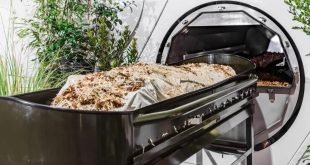
“Every body can help the planet” is the tagline of Earthly Remains, a not-for-profit organisation set up to advocate for human composting as a more sustainable death care option in Australia.