Planetary Health NewsStrengthening community and restoring the health of our planet.
Dr Keith Suter on Making Peace in the World Today
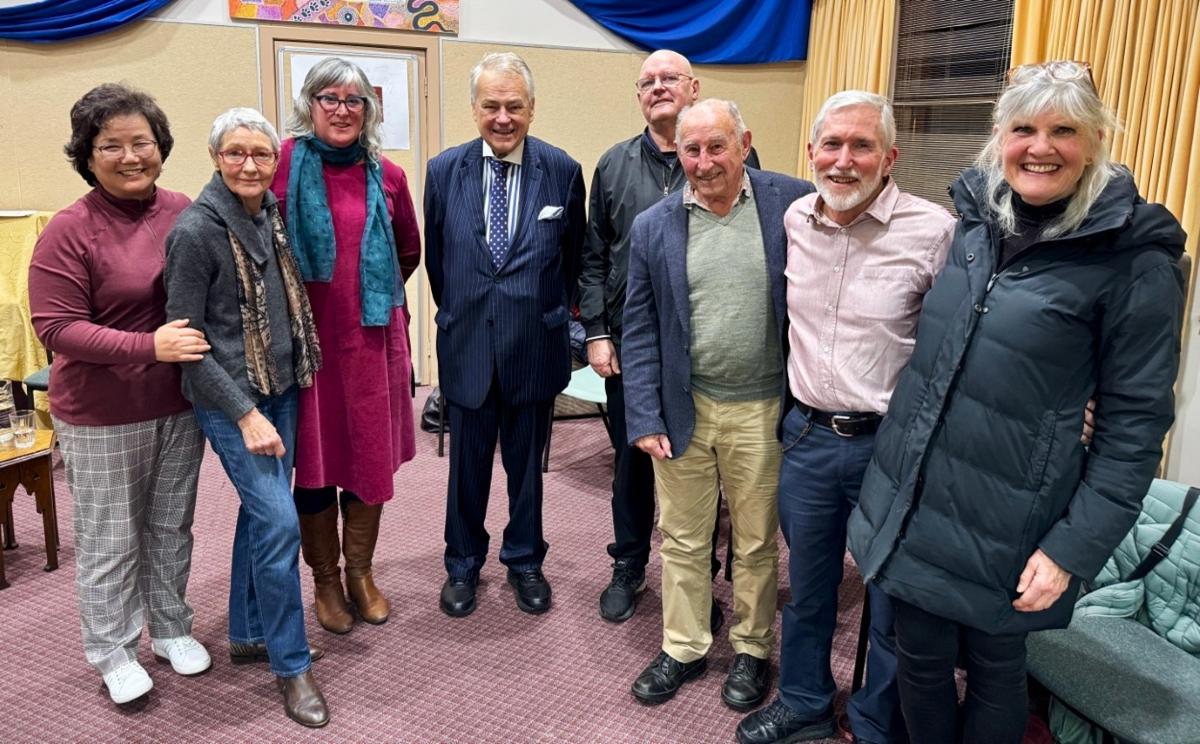
Dr Keith Suter (fourth from left) with members of the Blue Mountains Peace Collective.
Recognising how violence and war impact the health of the planet, the Blue Mountains Planetary Health Initiative has become a member of the Blue Mountains Peace Collective. On Sunday 25th May, members of the Collective attended a presentation by Dr Keith Suter on Making Peace in the World Today at the Leura Uniting Church.
Key Points:
The Doomsday Clock, which estimates humanity’s proximity to extinction, has been moved to 89 seconds to midnight.
There are steps all of us can take to grow a global movement for peace.
By adopting a Planetary Health approach – one that recognises the interdependence of human health and the health of our social, economic and environmental systems – we can forge a more peaceful, secure future.
The ‘dis-integration’ of the world through an increase in violence and war is creating an existential threat to all life. This year marks the sober 80th anniversary of the atomic bombings of Nagasaki and Hiroshima, which killed up to 246,000 people. It remains the only use of nuclear weapons in an armed conflict. For months afterward, many people continued to die from the effects of burns, radiationsickness, and other injuries, compounded by illness and malnutrition.
Since then, every year the Bulletin of the Atomic Scientists has set theDoomsday Clock: a metaphor for estimating humanity’s proximity to extinction.
Dr Keith Suter (AM) from Global Directions, a member of the Club of Rome, former President of the Centre for Peace and Conflict Studies at the University of Sydney, and well known media commentator, has written three doctorates: the first examined the international law of guerrilla warfare (University of Sydney), the second explored the social and economic consequences of the arms race (Deakin University) and the third doctorate analysed scenario planning (Sydney University).
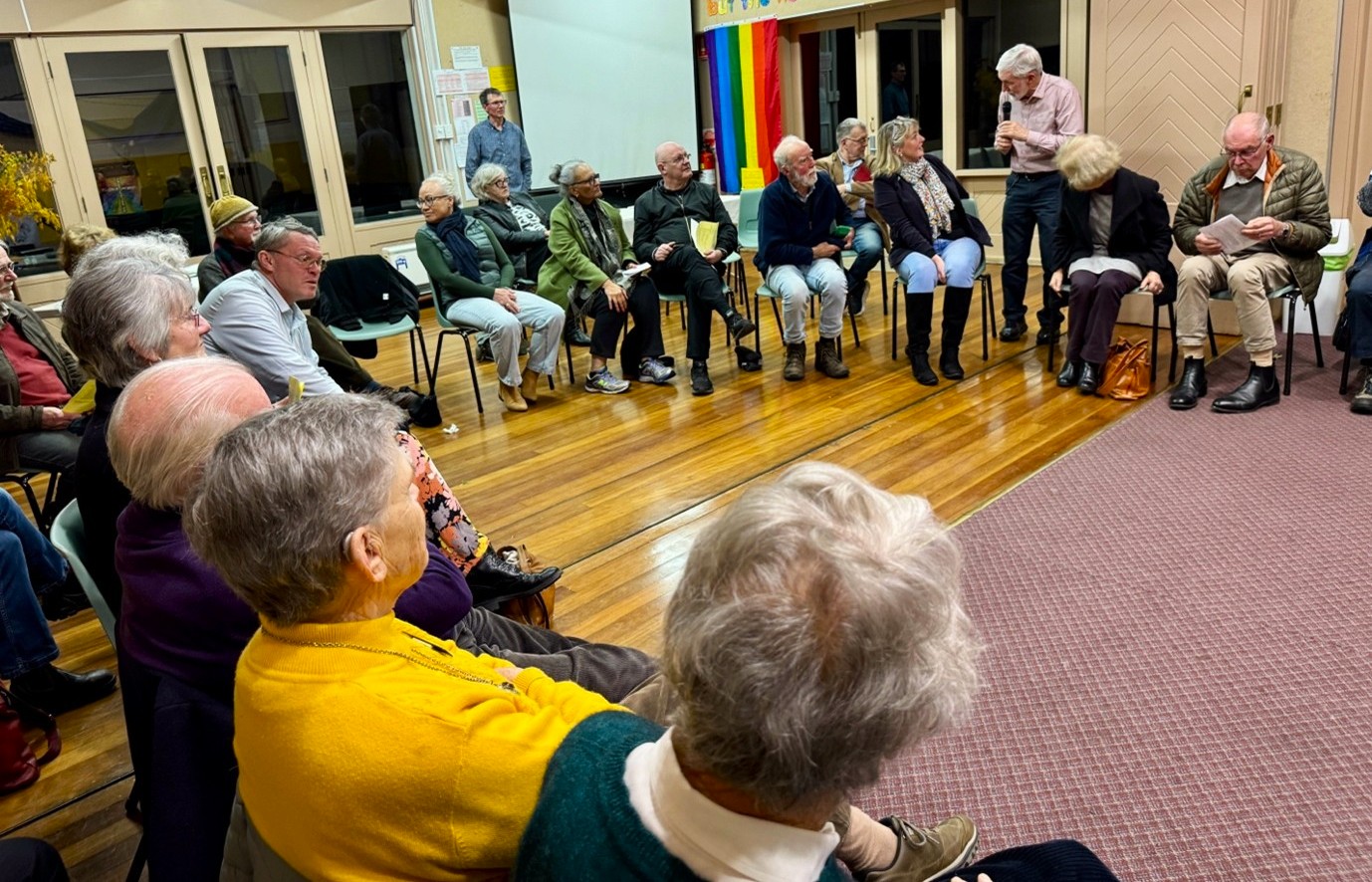
Members of the Leura Uniting Church and the Blue Mountains Peace Collective gathered to hear Dr Keith Suter on Sunday 25 May
At a community gathering in Leura, Dr Suter defined peace and the principles of working for peace, before outlining current global concerns and what we urgently need to do to stop the Doomsday Clock reaching midnight. In the question time following, he drew the link between climate change, environmental degradation and peace, and assured everyone that writing letters to politicians does have an impact!
You can watch Dr Suter’s full presentation in this video. Read further for a detailed outline of his talk.
Last month, the Permanent Secretariat of the World Summit of Nobel Laureates for Peace also hosted a webinar underscoring the inextricable link between Planetary Health, environmental sustainability and peace:
For peace to prevail in the long term, we must address these interconnected ecological determinants of human health. Climate change, environmental degradation, and health crises do not respect borders – they have the power to spark conflict, drive displacement, and deepen social inequities. By adopting a Planetary Health approach – one that recognizes the interdependence of human health and environmental systems – we can forge a more peaceful, secure future.
Below is an outline of Dr Keith Suter’s presentation:
MAKING PEACE IN THE WORLD TODAY – Dr Keith Suter
A resource for Twilight at Leura Uniting Church on Sunday 25th May 2025
INTRODUCTION: PEACE
What is “peace”?
More than simply the absence of war
It also involves co-operation and non-violent social change, aimed at creating more equitable and just structures in the communities and societies in which we live
Declaration of St James’ Palace June 1941:
The only true basis of enduring peace is the willing co-operation of free peoples in a world in which, relieved of the menace of aggression, all may enjoy economic and social security.
Principles of Working for Peace
Countries can win wars but lose the peace
“Violence” is not just about war alone: in the 20th Century more people were killed by their own governments than by foreign invaders
There has to be a change within each person
“Shalom”: wholeness
More than just about the scrapping of weapons: converting the weapons of war into the tools of peace: from swords into ploughs
Given the fallen nature of humankind, there will always be violence of some sort and so complete “peace” is not possible this side of the grave
Triangle of Peace
Disarmament
Conflict resolution
Search for justice
CURRENT CONCERNS
AUKUS: Australia, UK, USA
September 16 2021: AUKUS agreement is one of the most important foreign policy decisions in recent Australian history
Australian media tended to focus on submarines but the big picture is even more important; French submarine programme was over time and over budget
“China” was not mentioned in the three statements but was present throughout the media event
Are the decks being cleared for action against China? Variation of the “Thucydides Trap“? (Graham Allison); of 16 arms races in the last 500 years, 12 resulted in war
Risk of sleepwalking into a war with China
Taiwan could be the flashpoint to trigger a confrontation
In the recent general election neither of the two main parties questioned the viability of AUKUS
But New Cold War is Different from the Old One
The old Cold War (US-USSR, 1945-91) was mainly a military confrontation because the USSR was excluded from the world economy
New Cold War has China at the centre of the global economy (including via the Belt and Road Initiative: BRI)
How to oppose militarily a major trading partner?
THE BIGGER PICTURE
Basic Themes of Australian Foreign and Defence Policy
Fear of invasion
Fear that Australia cannot defend itself on its own; Australia is responsible for about 10 per cent of Earth’s surface
Need for a “great and powerful friend”
Payment of insurance premiums (beginning with the NSW troop deployments in UK’s 19th African conflicts) in the hope that the protector will come to Australia’s aid in a crisis
In short: Australia’s foreign and defence policy has been guided by the priorities of the senior ally (UK up to December 1941; now US e.g. Vietnam, “war on terror”, Afghanistan, Iraq)
There is little consistent public interest in this subject: people are anxious to be reassured that “something” is being done by “somebody” and then they turn their attention elsewhere, such as sport
Wider Context
Is China a threat to Australia? How should Australia respond to China-Taiwan tensions? Do we follow the US lead?
For the first time since 1788, Australia’s largest trading partner: isn’t part of the Western political/military alliance; isn’t part of the European cultural heritage; isn’t a developed country; isn’t a democracy: Yes: China is going to become the superpower, but it is doing things differently
How do we operate a fully-fledged nuclear-powered submarine fleet?
Can we trust the US? No country stays on top forever
“Armed neutrality”/ Swedish model: should Australia do more for its own defence and get rid of the US bases; reintroduce conscription; create compulsory forms of service in military and civilian corps, produce more of its own weapons; educate the general public to be more self-reliant?
“New Zealand” option: scrap much of the overseas military capability and reduce the US connection
Will “defence force modernisation” simply trigger local arms races and so would Australia be better off by not modernising and to seek to reassure the local region that it has no aggressive intentions?
Create a Ministry for Peace and do defence and foreign policy differently e.g. more economic and social co-operation?
Conclusion: there are plenty of alternatives to the current policy- but a lack of political will and public pressure to make changes.
Looking for a fun, educational and sustainable day out these school holidays?
Come along to Plate to Planet: Blue Mountains Food Security Fair in Katoomba on Saturday 10 October, with a line-up of free talks, activities and entertainment for all ages!
🌿 The Importance of Bioregions in Uncertain Times Join permaculture pioneer Rowe Morrow to explore how our land, water, food, energy and communities are connected - and how we can build a more resilient Blue Mountains.
🌱 Discover Old Man Saltbush Get up close to this remarkable native plant with Anne Elliot, and discover its potential as part of a more diverse and resilient food system.
🪱 Have a go at worm farming Learn how easy it can be to turn food scraps into valuable nutrients for your garden - with a hands-on worm farm activity from BMCC.
🎶 Enjoy live music Take a break, relax and soak up the atmosphere while enjoying live music by Olivia Dustmann throughout the day.
🎨 Kids` Corner - all day! Rock painting, crafts and story time, with plenty of fruit and veggie-inspired fun for younger visitors.
Explore local stalls, food, gardens, wildlife, sustainability and practical ideas for creating a more resilient food future.
Entry to the Fair and markets is free, with a range of free and paid sessions and workshops available throughout the day. Some sessions have limited capacity, so registration is recommended.
View the full program and register your place here: https://events.humanitix.com/blue-mountains-2026-food-security-fair
📅 Saturday 10 October | 9am–4pm 📍 Blue Mountains Planetary Health Centre, Katoomba...
Join Andris Heks, Yogic Psychotherapist, winner Best Actor, Blue Mountains, for his workshop to laugh as you never laughed before, as part of a movement to globalise people-bonding cheerfulness through kookaburra laughter contagion as an antidote to distressing world divisiveness.
Purchase your ticket here: https://events.humanitix.com/kookaburra-laughter-workshop
View the trailer and the GoFundMe page here: https://www.gofundme.com/f/globalise-unconditional-love-through-kookaburra-laughter
Key event information: - When? 10:15AM - 2:30PM, Sunday 4 October 2026 (1st day of Daylight Saving - 1 hour forward) - Where? Blue Mountains Planetary Health Centre, 33-39 Acacia St, Katoomba, NSW, 2780 - Fee? $60 or what you can afford - Note: please bring your own lunch
What to expect: - Learn how to stay cheerful for good - Learning the funny, human emulated, communal kookaburra laughter and meditation - How communal kookaburra laughter promotes bonding even amongst strangers - The awesome native treasure of the laughing kookaburra phenomenon - Why Kookaburra Yoga is the ‘most excellent of Yogas` - How communal kookaburra laughter contagion boosts the subtle and gross national product - How you could contribute to the kookaburra laughter contagion
This event is supported by Blue Mountains Planetary Health.
Purchase your ticket here: https://events.humanitix.com/kookaburra-laughter-workshop...
Come along to the Planetary Health Centre this Saturday for the next Skill Share Saturdays event!
This weekend`s agenda:
8:30AM - 10AM | Learn how to use your sewing machine class with Sherlie McMillan
8:30AM | Planetary Health Cafe open, serving Good Fat Pastry and Whisk and Pin
9AM - 10AM | Tai Chi and Qigong class with Virginia Field
10AM - 12PM | Learn how to grow WITH the Upper Blue Mountain permaculture workshop with Leni from Alchemy Farms
10AM - 3PM | Fashion Upcycling Workshop with Sherlie McMillan
10:30AM - 12PM | Learn to make focaccia from scratch with Laura Zucchetti (no experience needed)
1:30PM - 4:30PM | Planetary Health Bushcare with Karen Hising
For more information and to purchase a ticket, please visit the website: https://events.humanitix.com/skill-share-saturdays-at-the-planetary-health-centre...
Plate to Planet: Blue Mountains Food Security Fair 2026
📣HEADLINE SPEAKER📣
Our headline speaker is Julian Cribb AM – a renowned Australian science writer, journalist and author who has spent more than 50 years communicating science, agriculture, climate and global sustainability issues. He is the author of several influential books, including The Coming Famine (2010), Food or War (2019) and How to Fix a Broken Planet (2023), which explore the future of food systems, planetary health and humanity`s long-term survival.
He is widely recognised as one of Australia`s leading voices on global food security and sustainable development.
To register for his talk, and view the rest of the program, visit the website: https://events.humanitix.com/blue-mountains-2026-food-security-fair...
At our next Skill Share Saturdays event on Saturday 5th September, join Laura Zucchetti at 10:30am to learn how to make focaccia from scratch!
Come along for a 90 min class where you`ll mix, rest and stretch your own focaccia dough from start to finish, guided every step of the way. You’ll take home your dough to bake on the day in your own oven.
Sign up to this session, and view the other offerings on the day via this link: https://events.humanitix.com/skill-share-saturdays-at-the-planetary-health-centre...
Plate to Planet: Blue Mountains Food Security Fair 2026
We are pleased to announce that the program and registration for Plate to Planet: Blue Mountains Food Security Fair 2026 is now live!
Follow this link to view the program and register your place: https://events.humanitix.com/blue-mountains-2026-food-security-fair
Key information:
When? Saturday 10 October, 9AM - 4PM
Where? Blue Mountains Planetary Health Centre, Katoomba
Who is it for? Families, gardeners, enthusiasts, community groups and businesses, anyone looking to learn about how to be more resilient through local and sustainable food systems.
What to expect? Talks, workshops, demos, market stalls, family activities, music, food
Is there a cost? Entry to the Fair and Markets is free. Talks and workshops are ticketed (both free and paid) and have limited capacity, so please register in advance.
Program highlights:
🌏Headline talk: The age of renewable Food – Julian Cribb AM 🎋Wild edibles foraging workshops – Diego Bonetto, Eat More Weeds 🏞️The importance of bioregions in uncertain times – Rowe Morrow, Permaculture Matters 🥒Home canning and food preservation workshop – Kirsty Berté, Permaculture Hawkesbury Valley 🏡Designing your own Permaculture Property – Leni Nyssen, Alchemy Farms 🍃Utilising what’s in front of you – Uncle Lex, The Ganya Shed 🪱How to worm farm - BMCC 🎸Live music by Olivia Dustmann 🌾Community crop and seed swap
Tickets are limited so please register your place now: https://events.humanitix.com/blue-mountains-2026-food-security-fair
We are also seeking stallholders for the event. If you are a grower, retailer, community organisation or business that would like to get involved, please reach out to [email protected]!...
Thank you to everyone that joined us at the Planetary Health Centre on Saturday for the first of our Skill Share Saturdays program!
The Centre was a hive of activity all day, and we heard from @alchemyfarms_permaculture, the @ediblegardentrailbluemountains team and Andy Mann. Also thanks to Sherlie McMillan from Greater Blue Mountains Rotary for teaching the Fashion Upcycling workshop, and Virginia Field for the Tai Chi and Qigong class.
The next event will be held on Saturday 1st August - you can register your place here: https://events.humanitix.com/skill-share-saturdays-at-the-planetary-health-centre
🖐Get involved!
Do you have a skill, program or interest that promotes planetary health that you`d be willing to share with members of the local community? We are looking for more workshop and session hosts for our future events.
Join us at the Planetary Health Centre in Katoomba on the first Saturday of every month for Skill Share Saturdays!
Our July program includes: - What to grow in a Blue Mountains climate - Eating for Earth - Tai Chi and Qigong - Fashion upcycling and clothing reuse workshop - How to get involved with the Edible Garden Trail
You are also welcome to bring any surplus seeds or produce for our Crop Swap, or wind down in the Planetary Health Cafe (until 2pm).
If you have a skill that you want to share, or any questions or queries, please contact [email protected]
Visit the website to view the full program of events and register your place.
Join Andy Mann, a 23 year old Lawson local, for their Eating for Earth session 🌏
Eating for Earth is a judgement-free plant-based educational workshop that all types of eaters are encouraged to attend. There will be a presentation about the environmental impact of diets, a discussion section, and best of all, food! The food will be fully plant-based.
Andy wants to help inform our passionate community about how we can better reduce dietary environmental impact.
The session will run from 11AM - 12PM on Saturday 4th July.
Other sessions include: - What to grow in a Blue Mountains Climate - Fashion Upcycling - Tai Chi and Qigong - Bushcare on the Planetary Health site - How to get involved with the Edible Garden Trail
To register your place, visit our website: https://events.humanitix.com/skill-share-saturdays-at-the-planetary-health-centre...
We’re excited to announce the second Blue Mountains Food Security Fair, taking place in Katoomba in October 2026.
This annual event will bring together growers, thinkers, makers, and community members to explore one of the most important challenges of our time: how we grow, share, and sustain food in a changing world.
Across the weekend, we’ll be exploring themes including: - Healthy soil and regenerative systems - Food and human health - Plant-based food futures - Home and community food resilience - Water-sensitive and climate-adapted growing - Indigenous food knowledge and systems - School food systems - Australia’s food procurement - Global food security challenges Expect a dynamic program of inspiring speakers, practical workshops, and hands-on experiences designed to leave you informed, empowered, and connected.
Key information Date: Weekend of 10th October 2026 Location: Blue Mountains Planetary Health Centre, Katoomba, NSW We’ll be announcing speakers and program details soon.
We are also inviting expressions of interest from individuals and organisations who would like to contribute to the program, host workshops, run a stall or partner with us.
Do you struggle making the most of your veggie garden all year round?
Join Leni from @alchemyfarms_permaculture on Saturday 4th July for her Permaculture Workshop: Learn how to grow WITH the Upper Blue Mountains seasons, rather than battling against them.
During the two-hour session, you`ll cover crop selection for different seasons, what to grow from seeds vs seedlings, frost and wind protection, and nurturing your soil with a seasonal cycle.
Register for this and other sessions as part of our Skill Share Saturdays program via this link: https://events.humanitix.com/skill-share-saturdays-at-the-planetary-health-centre...
“Every body can help the planet” is the tagline of Earthly Remains, a not-for-profit organisation set up to advocate for human composting as a more sustainable death care option in Australia.